Bristol was a major port for centuries before it was anything else, and ports drink. Sailors paid off after months at sea, merchants sealing deals, press gangs hunting the unwary — all of it happened in pubs, and a remarkable number of those pubs are still pouring. What follows are the old ones with the best stories.
One honest note before we start: pub history is where documentation goes to get comfortable. Traditional founding dates are often folklore, and the best tales rarely come with paperwork. We'll flag the difference as we go.
The Llandoger Trow — the storyteller
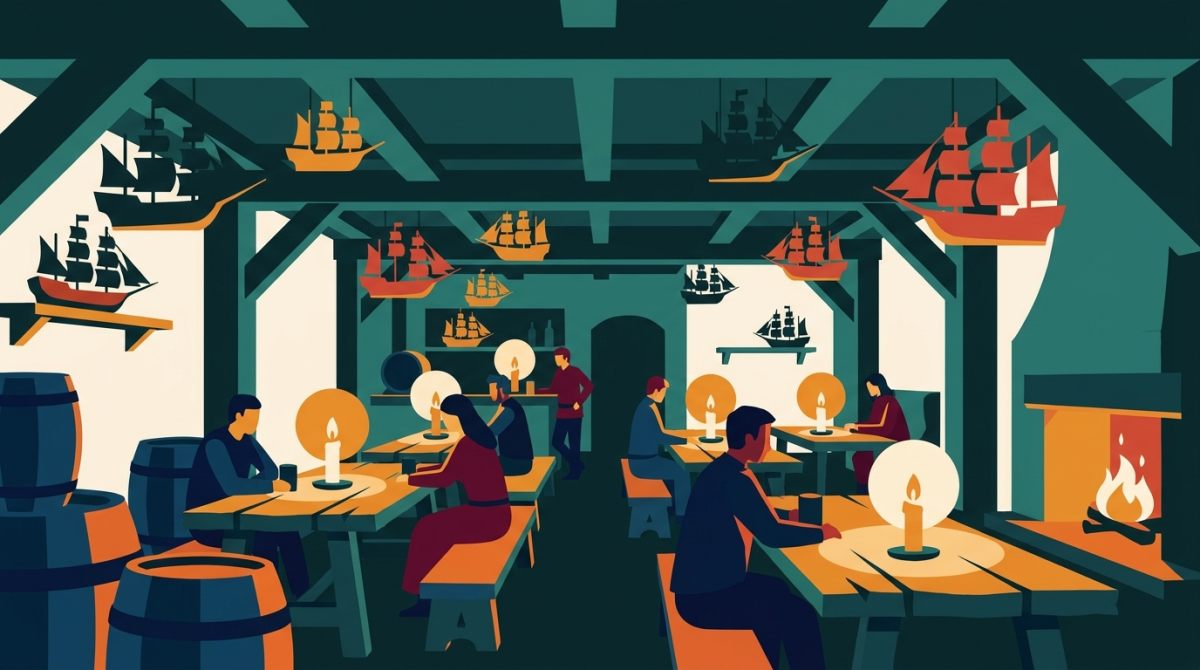
The timber-framed inn at the harbour end of King Street, usually dated to the 1660s, and the most storied building in Bristol drinking. The legends are magnificent: that Daniel Defoe met Alexander Selkirk here — the marooned sailor whose ordeal became Robinson Crusoe — and that the pub helped inspire the Admiral Benbow in Treasure Island. Neither can be proven; both have been told for generations; and the leaning, gabled building carries them well. Much of the old city around it was flattened in the Blitz, which makes its survival feel all the luckier.
It anchors the city's best short pub walk, which we've mapped in our pub-by-pub guide to King Street.
The Hatchet Inn — the old-timer
Traditionally dated to 1606, which would make it one of the oldest pubs in the city, the Hatchet stands near the centre with its thatch-era proportions intact and low doorways designed for smaller centuries. Its famous story concerns the front door: legend says the ancient layers of paint conceal a covering of human skin. It's a tale, not a finding — repeated for centuries, never verified, and frankly better that way. Underneath the folklore is a genuinely venerable pub that's watched the city change around it for four hundred years.
The Seven Stars — the important one
A small pub in a lane behind Victoria Street, and the one entry here where the history is documented rather than legendary. In 1787 Thomas Clarkson — the tireless investigator of the abolition movement — came to Bristol to gather evidence about the slave trade. The landlord of the Seven Stars helped him meet sailors who testified to the horrific conditions aboard the trading ships, and Clarkson's dossier fed the parliamentary campaign that eventually abolished the trade. A plaque marks it today. Of all the pints in Bristol, the one drunk here comes with the most weight behind it.
The Ostrich — the harbourside survivor
Down on the harbour by Bathurst Basin, The Ostrich is a Georgian-era dockside pub that has been serving the waterfront since the eighteenth century. Its stories run to sailors, smugglers and the caves in the red cliff behind it — connections retold with enthusiasm and, as ever with smuggling tales, best taken with a measure of salt. What's beyond dispute is the setting: it remains one of the finest places in Bristol to drink beside the water, and it earns its place on any walk from our Floating Harbour guide.
A note on "oldest"
Which is Bristol's oldest pub? Unanswerable, honestly. "Oldest" might mean the building, the licence, or continuous trading as an inn — three different questions with three different winners — and the traditional dates above are exactly that: traditional. Our advice is to let the pubs argue it out on their plaques while you concentrate on the more rewarding question of which one to sit down in first.
Walking them
The old city is compact, and all four pubs above sit within an easy loop of the centre and harbour — an unhurried afternoon covers the lot, with halves the sensible measure. Check current hours before setting out; even four-hundred-year-old pubs change them. If you'd rather have the city's beer story told to you along the way, that's the job our Bristol Craft Beer Experience has been doing since 2016 — a private harbour boat with tastings, a behind-the-scenes brewery tour at Moor, and a finish among King Street's old inns at The Beer Emporium around 4pm. Groups with a history bent are well served by a private tour, and a gift voucher covers the drinker who already knows all these stories and will enjoy correcting the guide.
Drink the history with a guide
The Bristol Craft Beer Experience crosses the harbour by private boat with tastings, goes behind the scenes at Moor Brewery, and finishes among the old inns of King Street with a beer flight, cheese and charcuterie. Four hours, £69 a head, everything included.
Common questions
What's the oldest pub in Bristol?
Contested, and cheerfully so. The Hatchet's traditional date is 1606 and the Llandoger Trow's the 1660s, but "oldest" can mean building, licence or trading history — and the dates themselves are folklore as much as record.
Which pub has real abolition history?
The Seven Stars — where landlord and premises helped Thomas Clarkson gather sailors' testimony against the slave trade in 1787. It's documented history rather than legend, and marked by a plaque today.
Did Treasure Island really start at the Llandoger Trow?
It's a legend — long told, unprovable, and part of the pub's furniture by now. The 1660s building, happily, is entirely real.
Can I do them all in a day?
Easily. All four sit within a walkable loop of the old city and harbour. Take the afternoon, drink halves, and check each pub's hours before you set out.
Pub founding dates and legends are traditional rather than verified unless stated otherwise above. Venues change hours without notice — please check directly before making a special trip.